Showing posts with label BIAB. Show all posts

Monday, 11 June 2018

Brewday 28/05/18 Motueka Pale

Pale and Hoppy

I always try to keep a good range of ingredients in stock so I can brew at short notice. I also tend to have recipes created in advance which (although usually subject to last minute tweaks) gives me the ability to brew some beer when the opportunity arises. This was case at here when despite it being half term the rest of the family were out all day and I only had a couple of hours of work to do. I had the ingredients to make a nice hoppy pale ale so I got the mash on early, nipped out to work, and was back after 2½ hours to finish the brew.

I recently bought some Motueka hops and yeast from Crossmyloof Brew Supplies who I believe are a contract brewer who also repack hops and yeast to sell to homebrewers at very competitive prices. I had never dealt with them before so I was interested to see how the ingredients performed, especially the yeast which was their US Pale Ale Yeast.


Recipe BIAB

  • Mash for 150 mins at 67°C
  • Boil for 60 minutes
  • Mash water volume 29.3lt
  • 2.7kg Maris Otter
  • 0.5kg Munich Malt
  • 200g Flaked Maize
  • 200g Wheat Malt
  • 100g Crystal Malt 45L
  • 100g Carapils
  • 15g Northdown 60 mins
  • 12g First Gold 15 mins
  • 50g Motueka whirlpool 20 mins
  • 33g Perle dry hop 4 days

Results

I pitched the yeast at 20°C which was about as low as I could get it during the UK's current never-ending warm spell. I also put the fermenter in a pan of cold water wrapped in a damp towel to try and keep the temperature down during fermentation which was fairly successful, the temperature stayed at around 21°C. Fermentation was very quick, the gravity reading was down to 1.010 after 3 days. I bottled the beer after one week.
OG: 1.040
FG: 1.008
ABV: 4.15%
The beer was pretty cloudy when I bottled it and the yeast was not as flocculent as others I've used, the yeast cake after fermentation was not as compact as usual. In fact bottling took far longer than usual with blobs of yeast blocking the bottling wand. I think the warm weather has affected the fermentation. However it seems to be clearing up in the bottles so hopefully it will end up as good hoppy pale ale.

Monday, 18 December 2017

Brewday 08/12/2017 Another Porter

Brown Stuff

I had one last opportunity to brew in 2017 so chose to make a porter. I had some dark malts in stock and I could use some more homegrown hops and free up some space in the freezer. 


Recipe (BIAB):

  • Mash for 90 mins at 66°C
  • Boil for 60 mins
  • Mash water volume 28lt
  • Pale Malt 3.5kg
  • Munich Light 0.5kg
  • Crystal 60L 200g
  • Chocolate Malt 240g
  • Black malt 60g 
  • Rolled Oats 250g
  • Northdown 7% 15g (60 mins)
  • Northdown 7% 25g (15 mins)
  • First Gold (homegrown) 25g whirlpool 75°C for 30 mins
  • Cascade 4.2% 25g whirlpool 75°C for 30 mins
  • First Gold (homegrown) 63g dry hop for 3 days 
  • Gervin GV12 English Ale Yeast 11g pack
  • Recipe in Brewers Friend
The whirlpool addition is a bit of a misnomer, I just chilled the wort to 75°C, added the hops, gave it a stir and left it for 30 minutes before finishing chilling. This should get more aroma from the hops as opposed to adding at flameout when the wort is still at boiling point.

Results 18/12/2017

I bottled this after 10 days in the fermenter.
OG 1.049 (efficiency 70%)
FG 1.009
ABV 5.17%

I'll give it a couple of weeks conditioning and try some in 2018, hopefully it will be good, the sample I tried from the gravity reading was very tasty!


Update 31/01/2018


Yep, still tasty!

Friday, 17 November 2017

Brewday 17/11/17 Kolsch

Impromptu Brewday

Due to a work cancellation I found I had the opportunity (and more importantly, the ingredients) to brew some beer. I had plenty of German malts so I decided to make another Kolsch.

Recipe BIAB:

  • Mash water vol 28lt
  • 3kg Pilsner Malt
  • 1kg Vienna Malt
  • 250g Wheat Malt
  • 150g Carapils Malt
  • 25g Perle 4.4% (60 min)
  • 25g Perle 4.4% (15 min)
  • 5g Irish moss (15 min)
  • 1 pk Safale K97 German Ale Yeast
  • Mash for 90 mins at 68ºC
  • Boil for 1 hour
  • 21.5lt into the fermenter

Results:

After recent poor efficiency scores I did a bit of research to see how I could improve things. One suggestion I came across was to mill the grains much finer than normal but since I buy all my grain pre-crushed that wasn't an option. Another common idea was mashing with a smaller quantity of water and then sparging. There are various options; cold water sparge, warm water sparge, dunk sparging, trickle sparging, all of which seem to have worked for other homebrewers. However the most straightforward suggestion was simply to extend the mash time to 90 minutes, which I did and it worked! I got a higher OG than anticipated due to the higher efficiency score, I was only expecting 1.045 at 70% efficiency.

Efficiency 75%
OG 1.048
FG 1.011
IBU 23
ABV 4.82% (expected)

So it's now fermenting away, I'll leave it for about 10 days before bottling. 


Update 28/11/2017

The K97 yeast has an ideal fermentation range of 15-20ºC, I pitched at 18ºC which was as low as I could reasonably get with my immersion chiller and 12ºC ambient water temperature. After 24 hours I noticed the temperature of the fermenter had risen to 20ºC, meaning I needed to chill it somehow. Short of emptying the fridge which wouldn't have been too popular I had to resort to a  more basic method. By wrapping the fermenter in a wet towel and standing it in a pan of cold water the temperature came down to 18ºC within 24 hours and stayed at 17ºC for the duration of the fermentation period. Luckily for me my fermenting buckets fit neatly inside my pan.

Hi-tech cooling system


Update 31/01/2018

After several weeks conditioning in a temperature controlled area (under the stairs - temperature 10-12ºC in January) I tried this beer and have to say am well pleased with the result. It's crisp and clean but with that distinctive Kolsch-y flavour. I think the attention I paid to temperature for fermentation and conditioning has paid off.


Unfiltered and unfined!

Wednesday, 4 October 2017

Brewday 25/09/17 - Red Rye Ale

It's rye time I did this...

I always enjoy any beer that features rye but I've never brewed with it myself until now. This beer also includes some of my homegrown First Gold hops so it's a double first - I hope it turns out well.


Recipe:

  • 3.15kg Irish Ale Malt
  • 0.5kg Red X Malt
  • 0.5kg Rye Malt
  • 0.5kg Munich Malt
  • 100g Chocolate Malt
  • 25g Northdown (60 min)
  • 25g First Gold (15 min)
  • 44g First Gold (0 min)
  • 50g Cascade (dry hop 4 days)
  • 36g Mosiac (dry hop 4 days)
  • 1 pk Safale S04 Ale Yeast
OG =1.045 (efficiency 68% - still not very good)
Anyway it's in the fermenter, I plan to bottle it later this week.


Update 06/10/17

I bottled the beer today, FG was 1.010 (exactly as predicted) giving an ABV of 4.57%. A quick taste suggests this beer will be a very pleasant drink once it has finished conditioning.

Sunday, 1 October 2017

Brewday 18/09/2017 - Black Coffee Stout

Black Coffee in Beer

With the nights drawing in it was time to brew a dark beer, and in a radical move I decided to add an extra ingredient to the usual line-up of water, malt, hops and yeast. This beer also contained coffee, and just to make it extra crafty I used cold brewed coffee. As this was a bit of an experiment for me I only brewed a small batch of nine litres split into two demijohns.

Recipe (BIAB):

  • Mash for 1 hr at 67°C
  • Boil for 60 mins
  • Mash water volume 13.6lt
  • Pale Malt 1.35kg
  • Crystal 15L 160g
  • Chocolate Malt 110g
  • Black malt 50g 
  • Rolled Oats 180g
  • Northdown 25g (60 mins)
  • Northdown 25g (0 mins)
  • Gervin GV12 English Ale Yeast 11g pack
  • 100ml cold brewed coffee (added to one demijohn)
  • Recipe in Brewers Friend
Naturally things didn't go totally as planned, firstly my efficiency was way down at 61% (usually I get around 75%) which meant I was going to end up with an ABV of 3.95%, a lot lower than what I wanted. I also managed to miscalculate the hop additions, this was a scaled down recipe but I didn't reduce the hops at the same rate as the malts resulting in a higher IBU rating than originally expected. Obviously I couldn't do much about the hops but I decided to increase the ABV by adding some brewing sugar (dextrose) to the fermenters. I made a solution with 80g of dextrose and 200ml of boiling water, allowed it to cool and then split it between the two demijohns. I have never done this before but it seemed to work. I made the addition after two days fermentation and there was certainly some increased airlock activity and a final gravity reading of 1.010 would indicate a theoretical ABV of 4.42% which is a bit of an improvement. The downside of adding sugar is it tends to make the beer taste thinner and less full-bodied but hopefully I've got the balance right by just adding a small amount. 

I made the cold brewed coffee by mixing 50g of coarse ground coffee with 350ml of water in a sterilised mason jar and leaving it in the fridge for 24 hours. I then filtered it several times to remove all the grounds and added 100ml to one of the demijohns after four days of fermentation. I left this for another week and then bottled both beers. Each demijohn contained 4.25 litres so I primed each with 20g of brewing sugar. Now I have 12 x 330ml of each stout conditioning, one with coffee and one without. It will be interesting to see how they compare and whether the coffee actually improves the beer. 


Friday, 9 June 2017

Brewday - 09/06/2017 Strong Bitter

Leftover Beer


I had sufficient spare ingredients left for one more brew, so I decided to make a strong bitter.


Recipe (BIAB):

  • Mash for 1 hr at 67°C
  • Boil for 60 mins
  • Mash water volume 30lt
  • Maris Otter 4.4kg
  • Crystal Malt 150g
  • Carapils 140g
  • Chocolate malt 12g 
  • Saaz 50g (60 mins)
  • Saaz 25g (15 mins)
  • Goldings 20g (15 mins)
  • Cluster 20g (15 mins)
  • Irish Moss 1 tsp (15 mins)
  • Goldings 22g (at turn off)
  • Gervin GV12 English Ale Yeast 11g pack
  • Cluster 22g (dry hopped 4 days)
  • Recipe in Brewers Friend

Results:

I got 23lt in the fermenter, the OG was 1.050 (slightly higher than expected!) and hopefully it should finish around 1.010 (5.1% abv) with 35 IBU's.
 Fermentation is going well!

Saturday, 3 June 2017

Bottling - Best Bitter

On The Eighth Day ...

... it was time to bottle the Best Bitter brewed on the 24th of May. 
Final Gravity was 1.010, ABV 4.6% and IBU 38. I think my recent brews have been a touch over carbonated, which is not good for a best bitter, so I primed this batch with 80g of sugar (about 1.8 vols of CO2) and bottled 21 litres in total. A quick sample tasting delivered a sweet malty flavour, pleasantly bitter with a little bit of hops in the background. I hope that after a couple of weeks of conditioning this will be a really nice beer. 

Thursday, 27 April 2017

Brewday 27/04/2017 Another Pale Ale

Yet Another Hoppy Pale Beer

I like dark beers and I like pale beers, last time I brewed a porter so it has to be a pale ale this time.

Recipe (BIAB):

According to my extensive research (several whole minutes online) head retention is aided by carapils malt, so I've used some in this beer.
  • Mash for 1 hr at 67°C
  • Boil for 60 mins
  • Mash water volume 32lt
  • Maris Otter 4.3kg
  • Carapils 250g
  • Crystal malt 150g
  • Simcoe 20g (at start)
  • Simcoe 30g (15 mins)
  • Cascade 30g (at end)
  • Simcoe 50g (dry hopped)
  • Irish Moss 1 tsp (15 mins)
  • Fermentis Safale S04 Yeast 11g pack
  • Recipe in Brewers Friend
I am aiming to get 22lt in the fermenter, OG 1.049 and 5% abv - hopefully.

Results:

I must have miscounted when filling the pan and actually used 32lt of water, as I got 25lt in the fermenter and OG 1.046. I expect a final gravity of 1.011 and around 4.6% abv. 

Wednesday, 22 March 2017

Brewday 22/03/2017 - Porter

American Porter 

Time to brew a porter I think. I have plenty of American hops so this will (hopefully) be a nice hoppy American Porter.


Grain Bill:

3.9kg Maris Otter
250g Chocolate Malt

100g Roasted Barley
125g Carafa III
230g Rolled Oats
I have used standard porridge oats, not flaked oats as usually used in homebrewing. Oats should add a creamy texture and a bit of body to the beer so I hope this works.
Recipe in Brewers Friend

Hops:


15g Galena 13.2% - at start of boil
45g Cascade 8.1% - 15 mins from end
20g Mosiac 12.5% - dry hop for 4 days
25g Cascade 8.1% - dry hop for 4 days


Yeast: Fermentis Safale S04 - 1 pack


Mash:

This was a BIAB recipe as usual.
Mash water volume 30lt
Mash for one hour at 66°C

Results:

I got 23.5lt in the fermenter, a bit more than anticipated but at least I get more beer. OG was 1.047, efficiency 77% (very good for me). I should end up with around 4.7% abv.

Update 31/03/2017:

The final gravity reading was 1.013, a couple of points higher than anticipated, so I got an ABV of 4.42%. Now conditioning so I'll taste it in a couple of weeks. 


Tuesday, 7 February 2017

Pale Ale brewday 07/02/2017

Pale Ale brewday 07/02/2017

This is similar to the pale ale I brewed in November 2016, but this time I will bottle it rather than put in the pressure barrel.

Recipe (BIAB):

  • Mash for 1 hr at 67°C
  • Boil for 60 mins
  • Mash water volume 30lt
  • Maris Otter 4.4kg
  • Carapils 200g
  • Crystal malt 70L 200g
  • Galena 20g (at start)
  • Amarillo 30g (15 mins)
  • Amarillo 45g (at end)
  • Citra 20g (dry hopped 3 days)
  • Irish Moss 1 tsp (15 mins)
  • Gervin English Ale Yeast 11g pack
Hopefully I should get 21-22lt in the fermenter.


Results:

I ended up with 23lt in the fermenter and 1.050 OG, exactly as predicted! Hopefully I 'll get a final gravity reading of 1.012 giving 5% ABV.


Update 15/02/17

Actual FG was 1.011, so ABV = 5.1% and attenuation = 78%.
Final bottle count was 42 x 500ml, should keep me going for a bit!

Tuesday, 31 January 2017

Brewday 31/01/2017 - Scottish 100 Shilling Ale

William Younger 1879 100/- Scottish Ale

This is a historic recipe provided by top beer writer Ron Pattinson whose blog Shut Up About Barclay Perkins is a great source of old ale recipes. I'm brewing this 100/- ale as part of a homebrew event where members of Manchester homebrew club and my group Chorlton home brewers are brewing several of these 19th century Scottish ales to bring to a tasting with Ron at Beer Nouveau in Manchester on April 2nd. I'm not sure how we'll know if they taste authentic but hopefully they will all be great beers.

Recipe

This is a very simple recipe!
Pale Malt (I used Golden Promise for extra Scottish authenticity) 5kg
Cluster 90mins - 58g
Goldings 30mins - 58g
Yeast - WLP028 Edinburgh Ale Yeast
OG should be 1.070 and I'm aiming for 17lt into the fermenter.

Results

Not brilliant, I got 16lt in the fermenter but an OG of only 1.060. That's only 62% efficiency, I usually get about 75%. Hopefully the yeast will achieve 70-75% attenuation resulting in an ABV of 5.8% which is close to the original recipe specification. The difference between my recipe and the brewing record is the level of apparent attenuation, the historic recipe has apparent attenuation at 63% which is low for this yeast strain.


Tuesday, 24 January 2017

Brewday 24/01/17 - Altbier

First Brewday of 2017

One advantage of being temporarily unemployed is having plenty of time to make some beer. Now I've finished decorating the hall I can concentrate on more important issues. I've got a bit of a thing about German ales, I've made Kolsch a couple of times but never an Altbier so this is my first attempt.

Altbier recipe BIAB

  • Mash for 1 hr at 66°C
  • Boil for 75 mins
  • Mash water volume 30lt
  • Munich malt 2kg
  • Pilsner malt 2kg
  • Carapils 300g
  • Caramunich III 500g
  • Carafa III 60g
  • Halletauer MF 80g - whole leaf (at start)
  • Saaz 25g - pellets (30 mins)
  • Irish Moss 1 tsp (15 mins)
  • Fermentis K97 German Ale yeast 11g pack
  • Recipe in Brewers Friend

Results

Ended up with 20lt in the fermenter and pitched yeast at 18°C. A bit less volume than I intended but there was a fair amount of hoppy gunk left in the pan which I discarded. 
OG was 1.050 which is exactly as forecast! 
I've been hoping to use this yeast for a while but I haven't seen it in 11g packs before, only the 500g size seemed to be available in the UK until recently.


Thursday, 24 November 2016

Kolsch - update

Kolsch type beer 

A quick update on my Mancunian Kolsch as originally described here
It's now a lot clearer and more carbonated. I am quite bemused by the change in flavour since I last tried it, the sweet fruity yeasty flavour has gone completely and it's now a lot drier than it was before. All in all, a vast improvement after 7½ weeks of "temperature controlled" bottle conditioning (3 weeks in a micro brewery cold store, 4½ weeks in my shed).

Sunday, 20 November 2016

Quality control - Porter

Tasting Porter brewed 20/10/2016

Colour looks ok!

I always get a bit nervous whenever I taste a homebrewed beer for the first time. There's an established chain of actions to go through. If it's a pale beer hold it up to the light and see how clear it is, although obviously not applicable in this case I try to see if the yeast sediment has settled at the bottom of the bottle. Next, I open the bottle and hopefully get the satisfying "pssst" noise and the plume of vapour swirling out of the top of the bottle. Sometimes this is followed by a bit of frothing but not the dreaded geyser/fire hydrant effect. In this case everything was encouragingly spot on. So far so good, but next it's time to actually taste the beer and for this Porter I was pretty well pleased. It's not quite as hoppy as I thought it might be but it is very well balanced, quite bitter but with no overpowering burnt or roasted notes and fairly dry, not too sweet with a slightly hoppy aftertaste. Phew! Better have another now, just to confirm my initial findings.


Friday, 18 November 2016

Brewday 18/11/2016 - Pale Ale

Pale Ale brewday 18/11/2016

Partner's at work, kids are at school, I'm at home. What should I do?
I could do some of those odd jobs that have been stacking up, a bit of decorating, a bit of DIY maybe, or I could do something far more constructive!


Recipe (BIAB):

Since I have enough ingredients to make a nice hoppy pale ale, that's what I'm going to do.
  • Mash for 1 hr at 67°C
  • Boil for 60 mins
  • Mash water volume 30lt
  • Maris Otter 4kg
  • Carapils 130g
  • Crystal malt 215g
  • Galena 30g (at start)
  • Mosiac 25g (15 mins)
  • Mosiac 55g (at end)
  • Citra 20g (dry hopped)
  • Irish Moss 1 tsp (15 mins)
  • Gervin English Ale Yeast 11g pack
Apparently Gervin English Ale Yeast is the same as Nottingham but only half the price. I've used it a few times and always had good results.

Hopefully I should get 21-22lt in the fermenter.


Results:

I ended up with 22.5lt in the fermenter. I was concerned that the OG was down to 1.040 (should have been 1.044) but hopefully I should still get around 4% abv. Efficiency was only 65%, I usually get about 75%.

Tuesday, 15 November 2016

Kolsch (type beer)

Home brewed Kolsch (-ish, made in Manchester)

I brewed this a few weeks ago and forgot to add some Irish Moss, it's still a bit hazy (15/11/16) but tastes good. I conditioned it for three weeks in the cold store at a friendly local micro and since then it's been further conditioned in my shed. I first tried it after bringing it back from the brewery and wasn't too happy as it had a bit of an apple flavour which fortunately has now faded after 2½ weeks of shed conditioning. Hopefully a few more weeks will clear it completely, standard home brew rules apply: if at first it doesn't taste right, leave it for a few weeks. It probably won't taste any worse.


Recipe (BIAB):

  • Mash for 1 hr at 67°C
  • Boil for 60 mins
  • Mash water volume 24lt
  • Pilsner malt 3kg
  • Carapils 375g
  • Spalt 33g (at start)
  • Spalt 17g (10 mins)
  • Spalt 15g (at end)
  • Hallertauer MF 23g (at end)
  • WL029 Kolsch yeast
Fermenter volume: 17lt
OG: 1.044 (a bit lower than expected - should have been around 1.050)
FG: 1.010
ABV: 4.5%
Brew date: 20/09/2016
Bottled: 04/10/2016

Thursday, 3 November 2016

Brewday 20/10/2016 - Hoppy Porter

My most recent effort brewed 20/10/2016

Not sure what to call this, a black IPA? Hoppy Porter?

Grain Bill:

4kg Maris Otter
200g Chocolate Malt
120g Roasted Barley
80g Carafa III

Hops:

35g Galena 13.2% - at start of boil
20g Citra 13.7% - 15 mins from end
40g Citra 13.7% - at end of boil
25g Amarillo 10.1% - at end of boil

Yeast: Fermentis Safale S04 - 1 pack

The Mash - 60 mins

  1. Add 29lt water to pan and heat to 70°C. Turn off heat.
  2. Put bag in pan and add grains slowly. Mix well to avoid clumping.
  3. Check temperature, should now be 68°C. Add heat if necessary but ensure you do not burn the grain bag! A false bottom in the pan helps to avoid burning.
  4. Replace lid and leave for 60 mins. Have a beer, walk the dog, etc.
  5. Carefully lift out bag allowing the hot wort to drain into the pan. I tend to put the grain bag into a fermenter with an upturned colander in the bottom and leave it to drain some more. You can then squeeze the bag to extract as much wort as possible. In this case I ended up with about 27.5lt of wort in the pan.
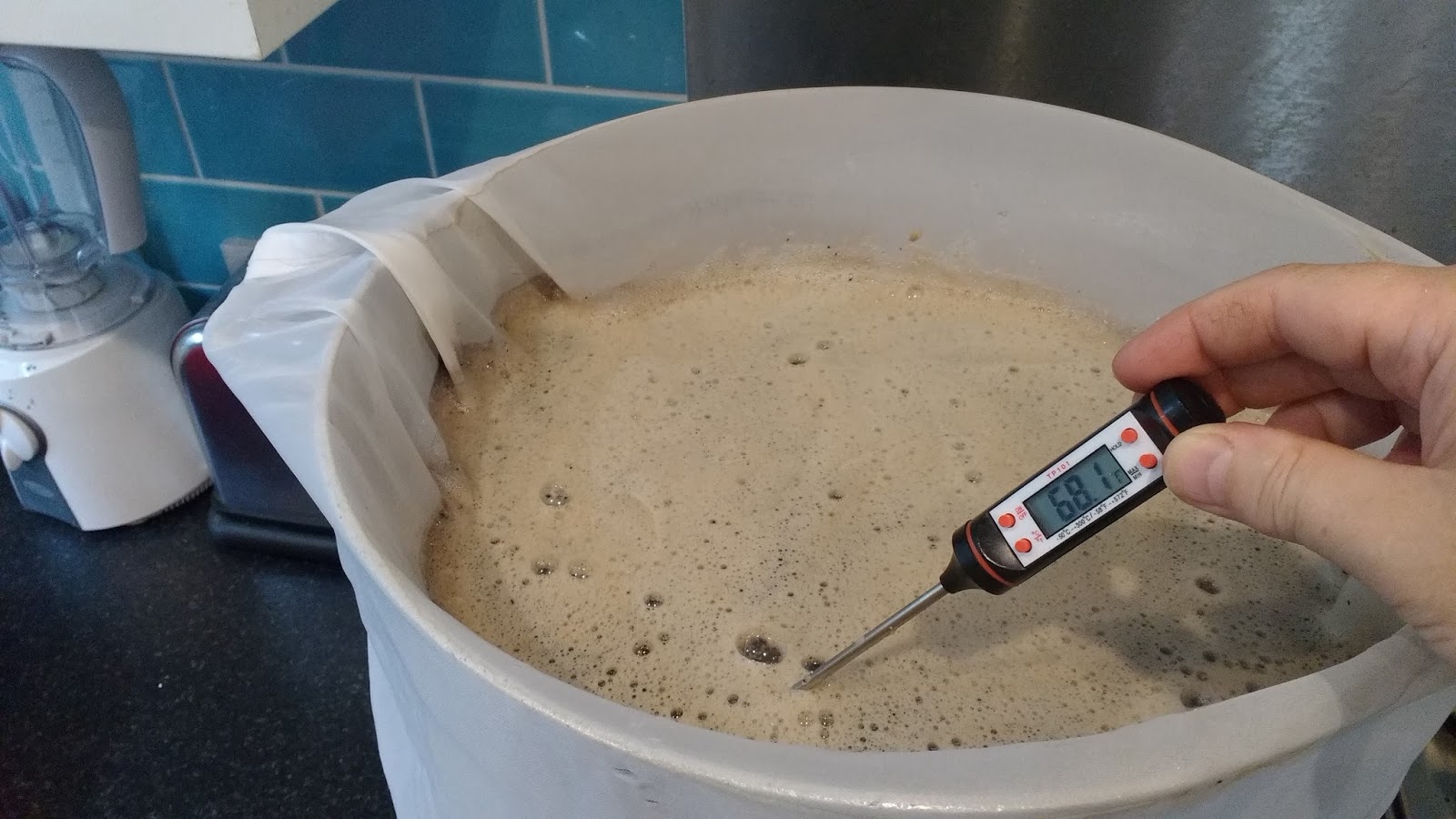
Temperature check after grains are added


The Boil - 60 mins

  1. Bring the pan of wort up to boiling and add the first hop addition, cover and leave to boil.
  2. After 45 mins add the next batch of hops. I also put my immersion chiller into the pan and bring back to the boil, this will sterilise the chiller. Boil for a further 15 mins and turn off heat.
  3. Add final quantities of hops and leave to cool for 10-15 mins.
  4. Connect immersion chiller to cold tap and chill the wort down to 20°C as quickly as possible
Chilling the wort


Fermentation

  1. While the wort is cooling I thoroughly sterilise the fermenter, seive, airlock and a plastic jug.
  2. Once wort is chilled down to 20°C it is ready to be transferred to the fermenter. Using the sterilised plastic jug pour the wort through the seive into the fermenter. I ended up with 21lt in the fermenter.
  3. Pour some wort into a test jar and take a hydrometer reading. In this case the OG was 1.050 which was exactly what was expected!
  4. Sprinkle the dried yeast onto the wort and seal the fermenter. Fill the airlock with previously boiled water and fit into the lid.
  5. Wait! The airlock should bubble away nicely for a few days, I usually leave the fermenter alone for at least 2 weeks before kegging or bottling.